Engineering case study · 2026-11-11
Prism Drop: a browser game from one sentence, on staging
The first build run end to end on PWR's staging environment: a Producer conversation, an approved plan, a team of agents, QA rejections and repairs, independent review, a delivered game and a feedback revision. Recorded in full, including the defects it exposed.
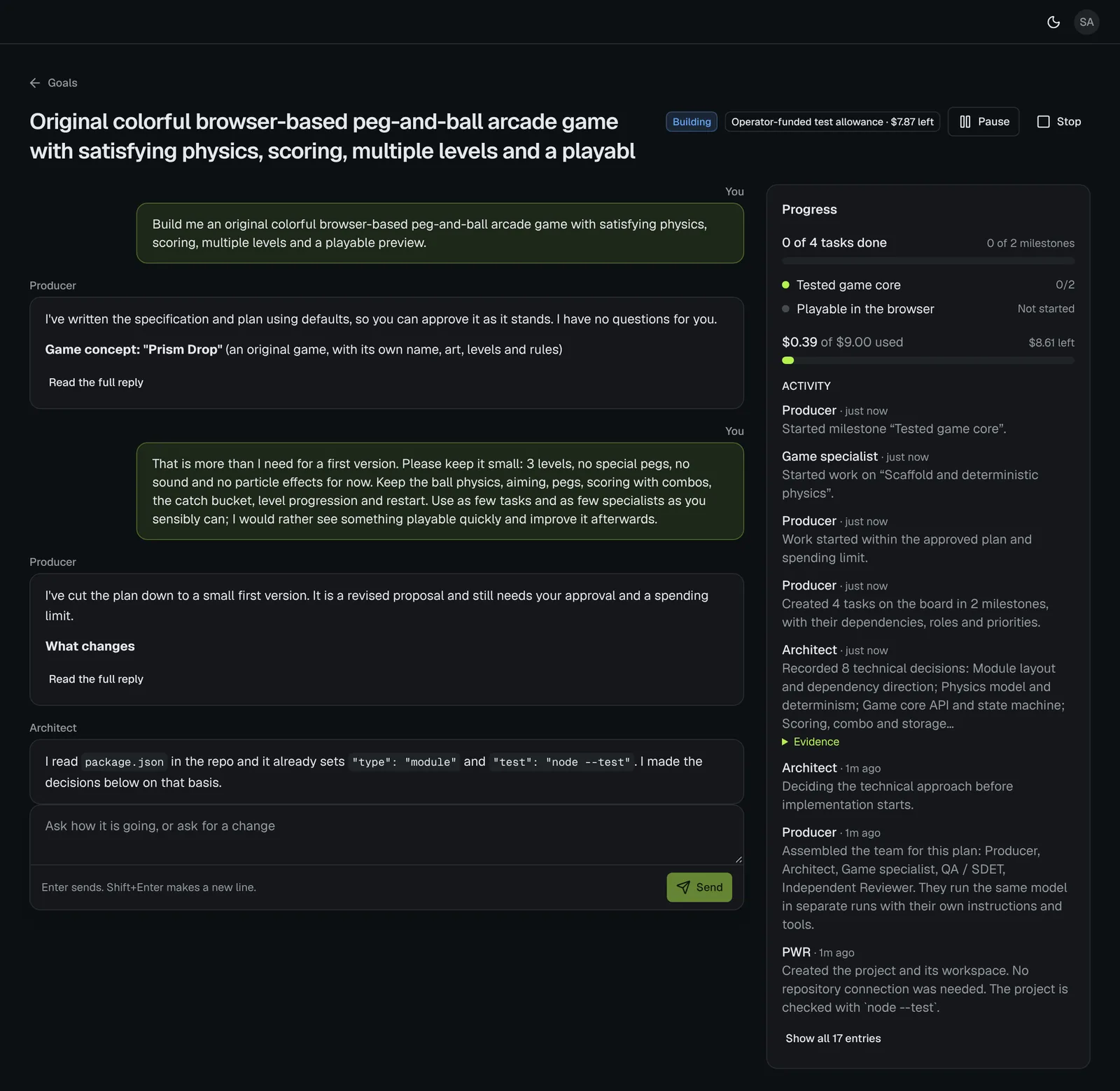
The task
Build me an original colorful browser-based peg-and-ball arcade game with satisfying physics, scoring, multiple levels and a playable preview.
What this run verified
- A Producer conversation produced a specification and a plan, and revised the plan when the customer asked for a smaller first version.
- The project and its workspace were created without a repository or a GitHub connection.
- Approval required a spending limit, and a second organization could neither start nor approve this goal.
- Implementation ran in the container sandbox; QA rejected work four times and it was repaired.
- An independent reviewer checked each task, and a headless browser check passed at desktop and mobile sizes.
- One feedback message became one follow-up task, which was implemented, checked and delivered.
- Asked later how the game was coming along, the Producer answered from the project's records, and the answer matched them on all but one figure.
What it did not verify
- The live preview inside Studio. The game was opened from the delivered files in a local browser.
- Anything about general reliability: this is one run of one small game on a staging deployment.
- Payment. The run was funded by a test allowance, not by a customer's plan or credits.
- Whether the game is good. The checks were automated; nobody judged how it plays.
- The cost against the provider's own bill. The recorded figure is about 18% under the list-price recomputation.
The numbers
- Environment
- PWR staging, a disposable test organization, a test allowance
- Approved plan
- Version 2: 2 milestones, 4 tasks
- Spending limit approved
- $9.00
- Team assembled
- Producer, Architect, Game specialist, QA, Independent Reviewer
- Agent runs for the first build
- 27 (Producer 5, Architect 1, Game specialist 8, QA 9, Reviewer 4)
- Findings
- 15 by QA and 6 by review; none left open
- Start to delivery approval
- About 12 minutes
- Recorded cost of the first build
- $2.11, including the planning conversation
- Same usage at provider list prices
- About $2.50
- Delivered
- 19 files, 38 KB: source and a static bundle
- Feedback revision
- 1 follow-up task, 6 runs, $0.90 recorded including two status answers; 22 files delivered
Source: the platform's own record of the run (docs/acceptance/evidence/2026-11-11-first-autonomous-build/ and docs/acceptance/evidence/2026-11-11-feedback-revision/ (README.md, conversation.md, browser-qa.json)).
What happened
Request and plan
One sentence from the customer. The Producer wrote a specification and a plan for a game it named Prism Drop, built on plain Canvas 2D because that is what PWR can build and test here.
A smaller plan
The customer asked for three levels and no sound or particle effects. The Producer cut the plan to 2 milestones and 4 tasks and said plainly that it had no measured history to estimate a cost from, so the limit would be the ceiling.
Build
The Architect recorded 8 technical decisions. The Game specialist implemented the four tasks in 8 runs inside the container sandbox.
QA and review
QA ran 9 times, rejecting one task once and another three times. The Independent Reviewer ran 4 times and left no blocking finding.
Escalation
The Producer had written a criterion for one task that only the later browser check could satisfy. QA spent three cycles on it before PWR escalated to the customer.
Delivery
The browser check passed, the customer accepted, and the work was committed to the managed repository.
Revision
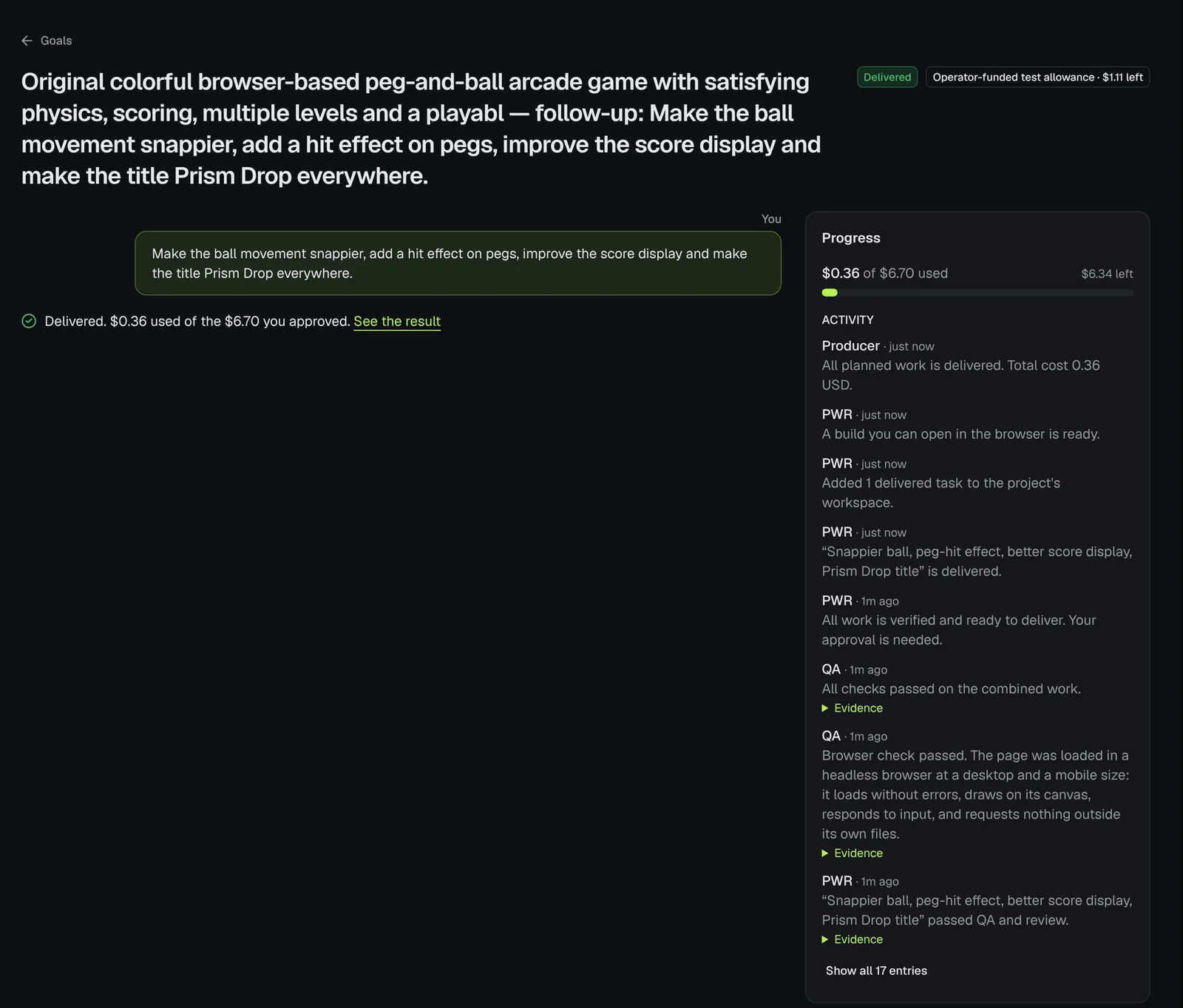
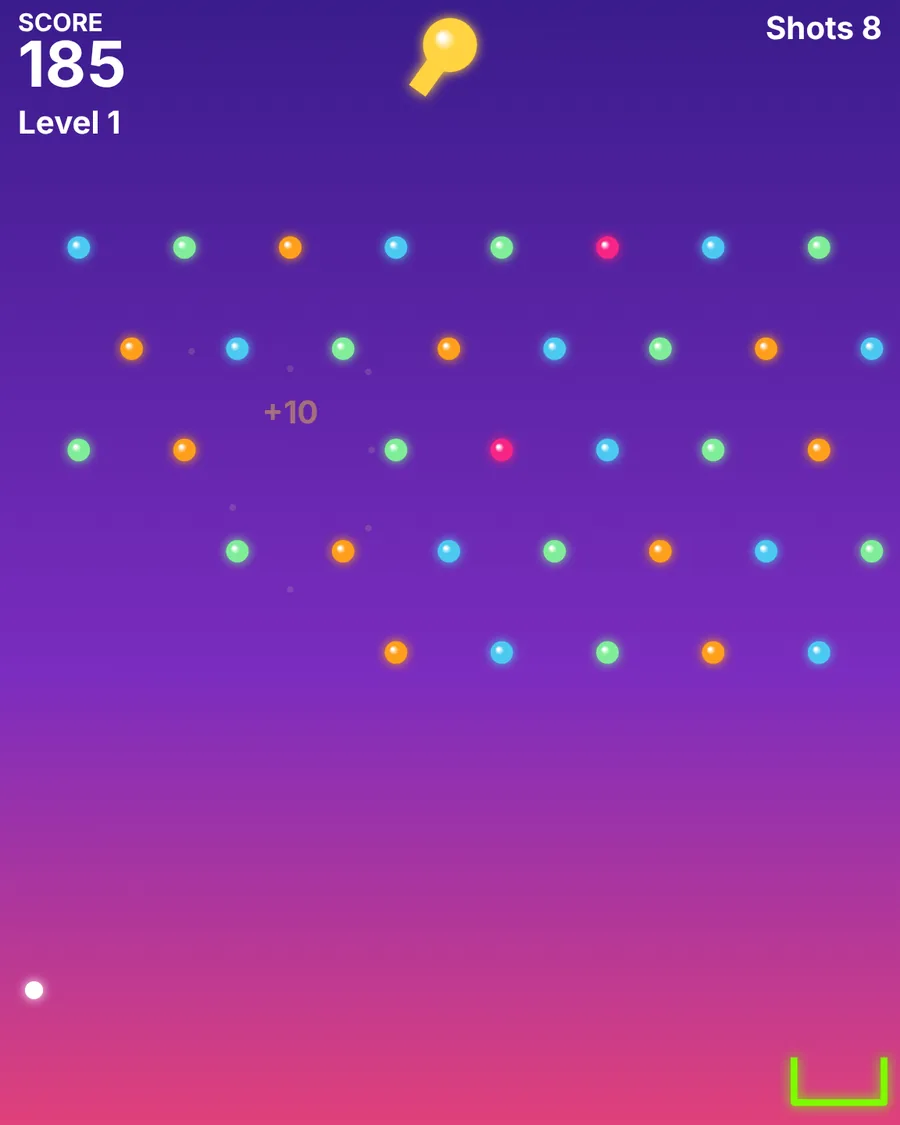
Feedback asked for a snappier ball, a hit effect, a better score display and the right title everywhere. The Producer found the wrong title itself, noted that the hit effect reversed the earlier 'no particle effects' instruction, and planned one task. It passed QA and review in one cycle.
What the run got wrong
The delivered game's title screen said 'Peg Arcade' rather than 'Prism Drop' until the revision. The result panel said nobody had opened the build in a browser although the browser check had passed. The first status answer missed the follow-up work; that was fixed and the second answer was correct.
Screenshots
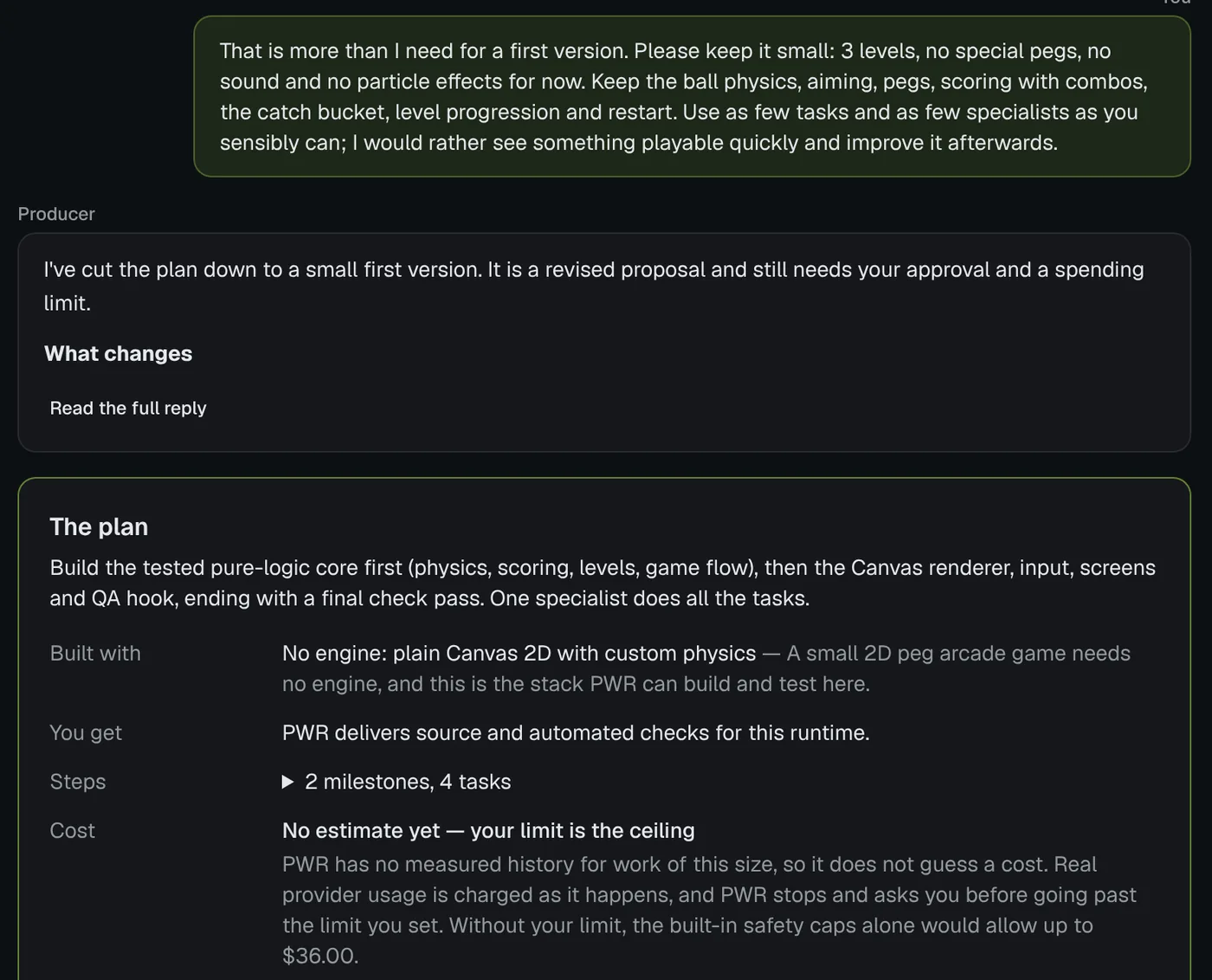
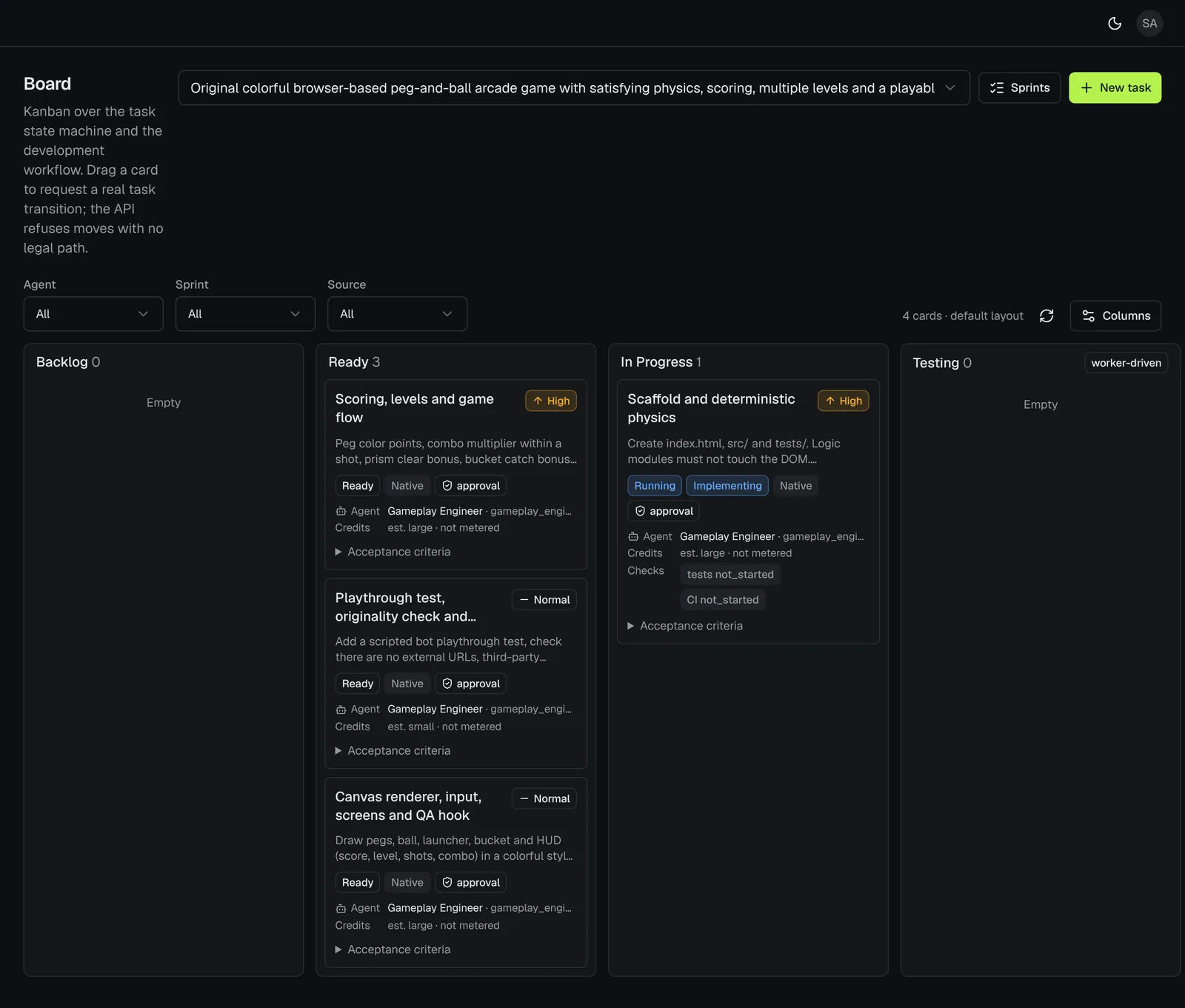
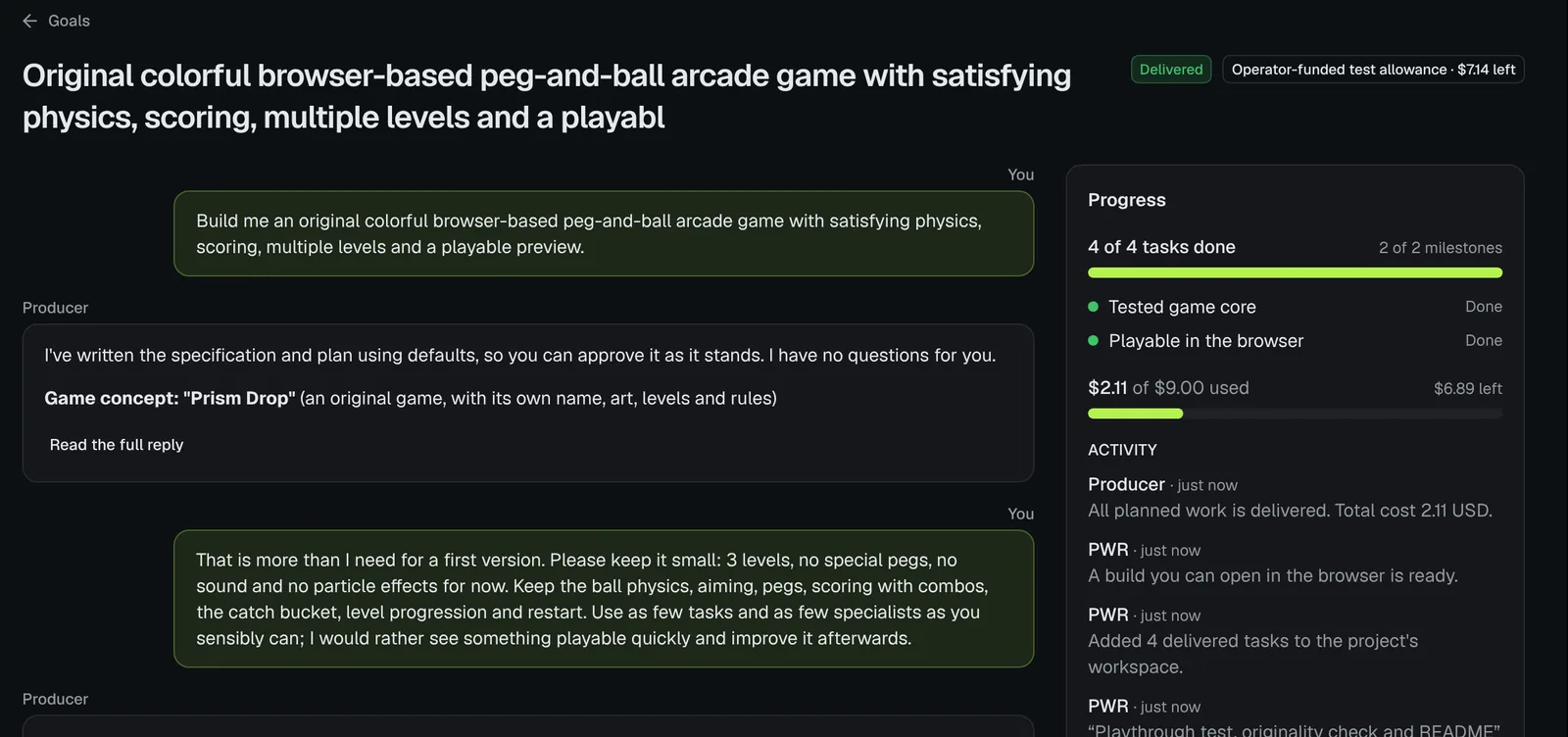
Where a person stepped in
- The customer asked for a smaller first version before approving.
- The customer approved the plan with a $9.00 limit.
- One task used up its revision cycles on a criterion it could not meet inside the task. PWR stopped and asked; the customer chose to try once more with guidance, and it passed.
- The customer accepted the delivery, then sent feedback, then accepted the revision.
- Before the run, three deployment defects stopped the first start at no cost and were fixed by the platform team.
The result
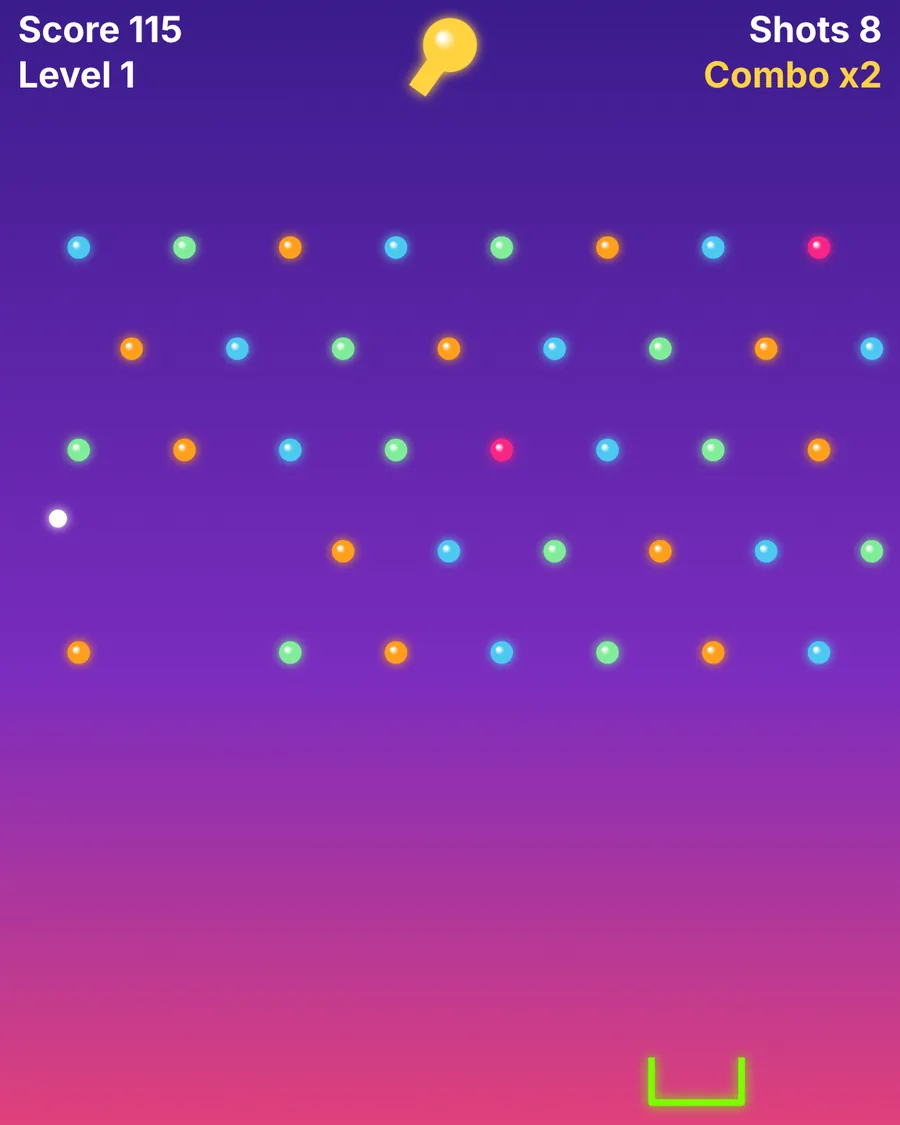
The game was delivered into a private staging workspace, so there is no public link to play it yet. The screenshots above are of the delivered files.